Art Meets Market: Where Creativity Sells in Sukhothai
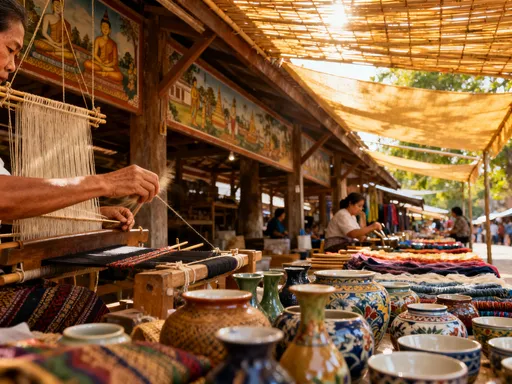
You know that feeling when ancient history and modern creativity collide in the best way? That’s Sukhothai’s art-driven commercial zones for you. I didn’t expect to find such vibrant craftsmanship in a historic Thai town—but here, tradition isn’t just preserved, it’s sold with soul. From hand-painted ceramics to silk woven with stories, every market stall feels like a gallery. This is more than shopping—it’s a cultural conversation. As sunlight filters through bamboo awnings and the scent of turmeric and clay lingers in the air, visitors don’t just observe heritage; they touch it, wear it, carry it home. In Sukhothai, commerce has become a quiet act of preservation, where every baht spent helps sustain centuries-old artistry.
Rediscovering Sukhothai Beyond the Ruins
Sukhothai is often celebrated for its sprawling Historical Park, a UNESCO World Heritage Site where lotus-bud stupas rise above centuries-old stone temples, and Buddha images sit in eternal meditation beneath banyan trees. Thousands of travelers arrive each year to cycle through these serene ruins, capturing golden-hour photos and marveling at the birthplace of Thai civilization. Yet, beyond the protected archaeological zone lies a living, breathing cultural landscape—one that pulses with creativity and daily rhythm. While the ruins tell the story of a past kingdom, the town’s commercial corridors reveal how that legacy continues to shape everyday life.
This shift from static monuments to dynamic marketplaces marks a growing trend in heritage tourism: the desire for authentic, participatory experiences. Travelers no longer want to merely look at culture through a lens; they want to engage with it, support it, and take a piece of it home—not as a generic souvenir, but as a meaningful artifact. Sukhothai’s art-infused markets fulfill this need by transforming routine shopping into a form of cultural immersion. Here, commerce is not separate from heritage; it is its continuation.
Walking through neighborhoods like Ban Mai or around the weekend walking street market, visitors encounter shopfronts adorned with hand-carved wooden signs, textiles dyed in earthy indigo and saffron, and ceramics fired in traditional kilns. These are not staged performances for tourists but genuine expressions of local identity. The town’s artisans do not see themselves as museum keepers; they are innovators who reinterpret ancestral knowledge for contemporary life. In doing so, they invite travelers to step beyond the temple walls and into the heartbeat of modern Sukhothai.
The Rise of Art-Centered Marketplaces
Over the past two decades, Sukhothai has quietly evolved into a model of community-driven cultural economy. What were once simple roadside stalls selling fruits and household goods have transformed into curated spaces where art and commerce coexist. This transformation did not come from top-down urban planning but from grassroots initiatives led by local families, cooperatives, and returning youth who recognized the value of their artistic heritage. Today, morning markets feature vendors displaying handmade soaps wrapped in banana leaf, while evening pop-up bazaars host live painting demonstrations and traditional music performances.
One of the most visible changes is the integration of public art into everyday commercial areas. Murals depicting scenes from the Ramakien epic or stylized lotus blossoms now grace the walls of small shops and cafes. These are not commissioned by foreign investors but painted by local artists, often students from nearby vocational schools. Street lamps are wrapped in woven fiber, and signage is hand-lettered in flowing Thai script. Even food vendors participate in the aesthetic—noodle bowls are served on ceramic plates crafted by village potters, and desserts are presented on banana leaves stamped with natural dyes.
What makes these marketplaces unique is their organic nature. Unlike commercialized tourist districts in larger cities, Sukhothai’s creative zones do not feel artificial or overproduced. There is no forced theme or corporate branding. Instead, the art emerges naturally from the community’s values and skills. A vendor selling herbal teas might display her wares in hand-thrown cups, each slightly imperfect and glazed with ash from rice husks. A tailor offering custom-fitted blouses uses silk woven on looms passed down through generations. Every product tells a story, and every space invites curiosity.
This blending of art and economy also supports sustainable development. By creating demand for traditional crafts, these marketplaces provide livelihoods that keep young people in the region rather than pushing them toward urban migration. It’s a quiet revolution—one where cultural pride fuels economic resilience, and where every purchase becomes an act of preservation.
Sukhothai’s Signature Crafts: Ceramics, Silk, and Sculpture
At the heart of Sukhothai’s artistic identity are three enduring crafts: pottery, silk weaving, and wood carving. Each represents a deep connection to the land, history, and spiritual traditions of northern Thailand. These are not mass-produced trinkets but carefully made objects that reflect time-honored techniques, often refined over centuries. Travelers who take the time to understand these crafts gain insight into the values and aesthetics of the local culture.
Sukhothai ceramics are perhaps the most iconic. Known for their warm, earthy tones and subtle ash glazes, these pieces echo the style of the ancient kilns that once supplied the royal court. Modern potters use locally sourced clay, shaping bowls, vases, and teapots on foot-powered wheels. After drying in the sun, the pieces are fired in wood-burning kilns at high temperatures, where falling ash creates natural glazes in shades of amber, green, and gray. The imperfections—slight warps, crackled surfaces—are not flaws but signatures of authenticity. Visitors can observe this process firsthand at small studios on the outskirts of town, where families welcome guests to watch, ask questions, and even try their hand at the wheel.
Silk weaving is another pillar of the region’s artistry. Unlike the bright, synthetic silks found in tourist malls, Sukhothai’s textiles are handwoven on wooden looms and dyed with natural pigments extracted from roots, bark, and flowers. Mulberry silk is spun into fine threads, then dyed in rich hues—deep indigo from the krimek plant, warm rust from jackfruit wood, and soft yellow from turmeric. The patterns often carry symbolic meaning, inspired by temple motifs, rice fields, or flowing rivers. Some weavers incorporate gold thread or intricate brocade techniques, creating fabrics used for ceremonial garments and heirloom pieces. Small cooperatives, often run by women, offer tours and workshops where visitors can learn about the months-long process behind a single scarf.
Wood carving, particularly in the form of Buddhist imagery and decorative panels, completes the triad of traditional crafts. Using teak and jackfruit wood, artisans carve serene Buddha figures, mythical guardians, and floral reliefs with meticulous detail. These carvings are not merely decorative; they are imbued with spiritual significance and often used in home altars or temple renovations. The tools are simple—chisels, mallets, and sandpaper—but the skill required is profound, passed down from master to apprentice within families. Some workshops allow visitors to witness the carving process, where the rhythmic tapping of wood echoes like a meditation.
Walking Through Art: The Layout of Creative Commercial Zones
Exploring Sukhothai’s art-centered markets is as much a sensory journey as it is a shopping experience. The layout of these spaces is not governed by rigid grids or corporate design principles but by organic flow and local rhythm. Narrow lanes, often unpaved, wind between open-fronted stalls made of bamboo and corrugated tin. Canopies of hand-painted fabric provide shade, fluttering gently in the breeze. The ground is sometimes covered in woven mats, inviting visitors to sit and browse at leisure.
Color dominates the visual landscape. Walls are painted in soft ochres, greens, and blues, often with hand-stenciled borders. Display tables are arranged with care—ceramic bowls stacked like lotus petals, silk scarves draped over wooden racks, and carved figures standing in quiet dignity. Labels, when present, are handwritten in both Thai and English, often with notes about the maker or technique. The absence of plastic packaging enhances the authenticity; goods are wrapped in cloth, paper, or banana leaf, reinforcing a commitment to sustainability.
Sound adds another layer to the atmosphere. The low hum of conversation blends with the occasional ring of a bicycle bell or the clink of pottery being carefully packed. In some areas, a radio plays gentle luk thung music, while elsewhere a weaver’s shuttle clicks rhythmically against the loom. The air carries a mix of scents—smoked wood from nearby kilns, the tang of natural dyes, and the sweetness of ripe mango from adjacent fruit vendors. It’s a multisensory experience that unfolds slowly, encouraging mindfulness and presence.
What stands out most is the accessibility of the creative process. Unlike galleries where art is behind glass, here it is lived and demonstrated. A potter might be trimming a rim while chatting with a customer. A silk weaver may pause to explain the meaning behind a pattern. These moments of interaction transform shopping from transaction to connection. The market is not just a place to buy—it is a place to learn, to appreciate, and to belong, even if only for an afternoon.
How Local Artisans Sustain Tradition Through Trade
Behind every handcrafted item in Sukhothai is a story of lineage, labor, and love. Many artisans come from families where skills have been passed down for generations, sometimes for over a century. A 65-year-old potter may have learned from his father, who learned from his grandfather during the early days of the Thai kingdom’s revival. A silk weaver might belong to a cooperative founded by her grandmother, who began weaving to support her children after her husband passed. These crafts are not hobbies—they are lifelines, sources of pride, and vessels of cultural memory.
What makes Sukhothai’s model sustainable is its balance between tradition and adaptation. Artisans do not resist modernity; they engage with it thoughtfully. A wood carver might accept custom orders for contemporary home decor while maintaining classical proportions. A ceramicist may experiment with new glaze combinations while preserving traditional firing methods. This adaptability ensures that the crafts remain relevant to today’s buyers without sacrificing their essence.
Moreover, the economic benefits of these markets ripple through the community. Income from sales supports not only individual families but also local schools, temples, and infrastructure. Some cooperatives reinvest profits into training programs for youth, ensuring that the next generation can continue the work. Others use part of their earnings to restore historic buildings or fund cultural festivals. In this way, the marketplace becomes a hub of social resilience, where art is both a product and a public good.
Travelers who understand this context often feel a deeper sense of responsibility. Purchasing a handwoven scarf is no longer just about acquiring a beautiful object; it is about participating in a cycle of care and continuity. Each item carries the imprint of someone’s hands, time, and heritage. And in return, the buyer receives not just a souvenir, but a story—one that can be shared, worn, and cherished for years to come.
Traveler Tips: Navigating Markets with Cultural Sensitivity
Engaging with Sukhothai’s art markets is a privilege, and doing so respectfully enhances the experience for both visitors and hosts. One of the most important principles is to approach artisans as creators, not just vendors. Taking time to ask about their process—how long a piece took to make, what materials were used, or what the design means—shows genuine interest and appreciation. Many artisans welcome these conversations and are happy to share their knowledge, especially when they sense respect.
Photography is common, but it should be done with permission. While it’s tempting to capture a weaver at her loom or a potter shaping clay, these are working environments, not performances. A simple smile and a polite gesture—holding up your phone with a questioning look—goes a long way. If the answer is no, accept it gracefully. In some cases, artisans may allow photos in exchange for a small donation, which supports their work and maintains dignity.
Pricing is another area where sensitivity matters. Handmade goods take hours, even days, to produce, and their cost reflects that. Bargaining is not expected and can be seen as disrespectful, especially when the price is already fair. If a price seems high, consider the labor behind it. Instead of negotiating, consider buying smaller items or returning later with a better budget. Supporting fixed prices also strengthens the market’s integrity and discourages a race to the bottom.
Finally, carry cash in small denominations. Many vendors do not accept credit cards, and digital payment systems are still limited in rural areas. Having baht on hand makes transactions smoother and shows preparedness. Bringing a reusable bag is also thoughtful, as it reduces waste and aligns with the community’s environmental values. Above all, approach the market with openness and humility. When you do, you’re not just a tourist—you’re a guest in a living cultural tradition.
Why This Model Matters for Heritage Tourism
Sukhothai’s fusion of art and commerce offers a powerful blueprint for heritage tourism worldwide. In an era where historic cities often face the dilemma of preservation versus development, Sukhothai demonstrates that the two are not mutually exclusive. Instead, when local creativity is valued and supported, tradition does not fade—it flourishes. The marketplace becomes a living museum, where culture is not frozen in time but continuously renewed through use and exchange.
This model challenges the notion that heritage must be protected behind ropes and glass cases. While archaeological sites like the Historical Park are essential, they represent only one dimension of cultural legacy. The other—equally vital—is the living practice of art, language, and daily ritual. By integrating craftsmanship into the economy, Sukhothai ensures that heritage remains accessible, dynamic, and economically viable. It proves that culture can be both preserved and participatory.
For travelers, this means a richer, more meaningful experience. Rather than collecting generic souvenirs, they take home objects with soul—pieces that connect them to people, places, and histories. For communities, it means dignity, sustainability, and intergenerational continuity. For the world, it offers hope: that amid rapid globalization, local identity can not only survive but thrive.
As more destinations seek authentic tourism models, Sukhothai stands as a quiet example of what is possible. It does not rely on grand infrastructure or international branding. Its power lies in the hands of its people, the rhythm of its looms, the glow of its kilns, and the warmth of its hospitality. Here, art does not merely meet the market—it elevates it. And in doing so, it reminds us that tradition, when lived and shared, never truly belongs to the past.