You Won’t Believe These Art Spots in Astana – Hidden Gems for Your Lens
Astana isn’t just a capital rising from the steppes—it’s a canvas. I never expected to find such bold art spaces in a city so often overlooked. From surreal sculptures to immersive galleries, every corner tells a story. If you're chasing unique photo moments, Astana’s creative heartbeat will surprise you. This is more than architecture; it’s raw, modern expression waiting to be captured. With its sweeping skyline and visionary urban planning, Astana has quietly become one of Central Asia’s most compelling destinations for art and photography enthusiasts. Beyond the glass towers and grand monuments lies a network of artistic expression that reflects both cultural heritage and futuristic ambition. For travelers seeking beauty with meaning, the city offers more than meets the eye—it invites deeper exploration, thoughtful framing, and emotional connection through the lens.
Why Astana Deserves a Spot on Your Art-Fueled Travel List
Astana, now officially known as Nur-Sultan for a period before reverting to Astana, has undergone one of the most dramatic urban transformations in recent history. Once a modest administrative center, it was designated as Kazakhstan’s capital in 1997, replacing Almaty. Since then, the city has evolved into a symbol of national pride and forward-thinking vision. But beyond its role as a political and economic hub, Astana has emerged as a growing center for cultural innovation. Art plays a pivotal role in this transformation, serving not only as aesthetic enhancement but as a narrative tool that communicates Kazakhstan’s journey from tradition to modernity.
The city’s leadership has invested heavily in architectural landmarks and public art installations, viewing them as essential components of urban identity. Unlike many capitals where art is confined to museums, Astana integrates creativity into everyday life—on sidewalks, in parks, and at the base of soaring towers. This accessibility makes the city particularly appealing to travelers who appreciate art that is both grand in scale and open to all. For photographers, this means endless opportunities to capture images that are not staged or restricted but organically embedded in the urban landscape.
What sets Astana apart is how its art reflects a unique blend of influences. You’ll see echoes of Kazakh nomadic culture in abstract forms, alongside sleek, futuristic designs inspired by global trends. This fusion creates a visual language that feels both familiar and otherworldly. Whether you're drawn to monumental sculptures, minimalist galleries, or architectural details, Astana offers a diverse palette for creative expression. And because the city remains less crowded than Western art capitals, you can explore at your own pace, finding quiet moments even in the busiest districts.
For family-oriented travelers, especially women aged 30 to 55 who value enriching experiences, Astana presents a safe, clean, and thoughtfully planned environment. The city’s wide boulevards, pedestrian-friendly zones, and excellent public transport make it easy to navigate with children or companions. Art spaces are often located near cafes, gardens, and rest areas, allowing for a relaxed itinerary. Moreover, the emphasis on beauty and harmony in Astana’s design fosters a sense of calm and inspiration—qualities that resonate deeply with those seeking meaningful travel beyond shopping or sightseeing.
The Abundance of Public Art: Sculptures and Installations That Pop
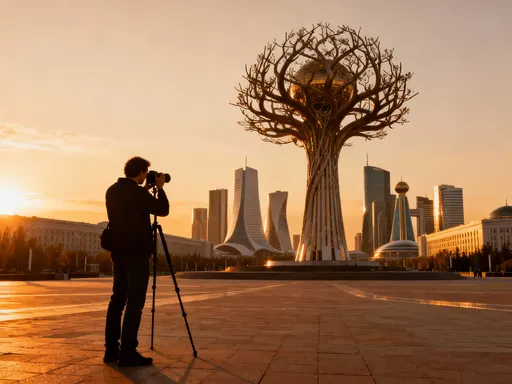
One of the most striking aspects of Astana is its wealth of public art. Unlike traditional capitals where sculptures are reserved for historical figures, Astana embraces conceptual and symbolic works that challenge perception. Among the most iconic is the Baiterek Tower, often referred to as the Tree of Life. Rising 105 meters above the ground, this gleaming structure features a golden sphere cradling a handprint—believed to be that of former President Nursultan Nazarbayev. While politically symbolic, the tower’s design draws from Kazakh folklore, where a mythical bird lays a golden egg in the branches of a sacred tree. Photographers are drawn to its reflective surface, which changes color with the sky, and its elegant curvature that contrasts sharply with the flat steppe horizon.
The best time to photograph Baiterek is during golden hour—just after sunrise or before sunset—when the light wraps around the tower like liquid gold. Shooting from a low angle emphasizes its height, while reflections in the surrounding water pool create symmetrical compositions. For a more intimate shot, visitors can step inside and place their hand in the presidential imprint, capturing a personal moment against the panoramic city view. Though some may see this as controversial, the experience remains a popular photo opportunity for families and solo travelers alike.
Another unforgettable installation is Waiting for Man, a series of bronze figures scattered across a grassy slope near the Presidential Park. Created by artist Zharaskhan Ibrayev, the piece depicts a woman and child gazing into the distance, evoking themes of hope, patience, and reunion. The emotional depth of the sculpture resonates with many, particularly women who connect with the universal experience of waiting and longing. To capture its full impact, photographers should visit in the late afternoon when the long shadows add drama to the figures’ silhouettes. A wide-angle lens helps contextualize the artwork within the vast open landscape, emphasizing isolation and anticipation.
What makes these installations so powerful is their ability to feel simultaneously alien and human. Their futuristic forms stand out against the natural terrain, yet the emotions they convey are timeless. This duality is central to Astana’s artistic identity—a city that looks ahead while honoring its roots. Other notable pieces include the Dome of Peace near the Palace of Peace and Reconciliation, adorned with intricate mosaics, and the Adai Gate, a modern interpretation of a traditional Kazakh yurt entrance. Each invites contemplation and creates a memorable photo story.
Inside the Museum of Modern Art: A Curated Visual Feast
For a deeper dive into Kazakhstan’s contemporary art scene, the Museum of Modern Art in Astana offers an immersive experience. Housed in a sleek, minimalist building with glass facades and angular lines, the museum itself is a work of art. Inside, rotating exhibitions showcase both established and emerging artists from across Central Asia. The curation emphasizes themes of identity, transformation, and cultural dialogue, making it a rich source of inspiration for thoughtful travelers.
One recent exhibition featured large-scale textile works inspired by traditional Kazakh embroidery, reimagined through modern techniques and abstract patterns. Another highlighted digital art that blends ancient mythology with futuristic visuals, creating dreamlike landscapes that challenge the viewer’s sense of time and place. These displays are not only visually captivating but also provide insight into how younger generations are reinterpreting heritage in creative ways. For photographers, the controlled lighting and clean backgrounds make it easier to capture high-quality images without the distractions of outdoor environments.
When photographing inside the museum, natural light from skylights and side windows often provides the best illumination. Using a higher ISO setting allows for clear shots in lower light, while avoiding flash preserves the integrity of the artworks and respects museum policies. A prime lens with a wide aperture (f/1.8 or f/2.8) can help isolate subjects and create soft background blur, enhancing the artistic effect. Tripods are generally not permitted for personal use, but handheld stabilization techniques—such as bracing against walls or using burst mode—can yield sharp results.
What makes this museum especially meaningful is its role in elevating local voices. Unlike some institutions that prioritize international names, the Museum of Modern Art dedicates significant space to Kazakh artists, giving them a platform to share their perspectives globally. This focus on homegrown talent fosters a sense of authenticity and pride. For visitors, it offers a rare chance to engage with art that speaks directly to the region’s soul—art that is not imported or imitated, but born from lived experience and cultural memory.
Hidden Galleries in Unexpected Corners
Beyond the major landmarks and official museums, Astana harbors a network of smaller, lesser-known galleries that offer intimate and authentic encounters with local creativity. These spaces are often tucked into business districts, cultural centers, or repurposed buildings, away from the main tourist routes. One such venue is the Atakent Art Cluster, located near the international exhibition center. Though modest in size, it hosts monthly exhibitions featuring painters, sculptors, and multimedia artists from across Kazakhstan. The atmosphere is welcoming, and staff are usually eager to discuss the works with interested visitors.
Another hidden gem is the Lumiere Gallery, situated within a quiet cultural complex near the Ishim River. Specializing in photography and light-based installations, it provides a contemplative space where images seem to breathe with the changing daylight. Exhibits here often explore themes of memory, family, and rural life—subjects that resonate deeply with middle-aged women who value emotional storytelling. Because these galleries attract fewer crowds, they allow for a more personal connection with the art, and photographers can take their time composing shots without feeling rushed or observed.
Finding these spaces requires a bit of curiosity and local inquiry. Asking hotel staff, café workers, or fellow travelers can lead to unexpected discoveries. Some artists even open their private studios to visitors by appointment, offering behind-the-scenes glimpses into their creative process. These interactions add depth to the travel experience, transforming passive observation into active engagement. For those who believe that art is not just to be seen but felt, these moments of connection are invaluable.
Exploring off-the-beaten-path galleries also supports the local creative economy. Many artists rely on direct sales and exposure to sustain their practice. Purchasing a small print or handmade piece not only brings a meaningful souvenir home but also contributes to the continuation of artistic expression in the region. For family travelers, sharing this experience with children can spark conversations about culture, creativity, and the importance of supporting artists in any community.
Photo-Worthy Architecture: Where Design Meets Art
In Astana, architecture is not merely functional—it is a form of artistic expression. Nowhere is this more evident than at the Khan Shatyr Entertainment Center, a towering tent-like structure designed by Norman Foster. Rising over 150 meters, its translucent ETFE membrane allows natural light to filter through, creating an ever-changing play of shadows and colors inside. From the outside, the building resembles a futuristic oasis, especially when illuminated at night. For photographers, capturing Khan Shatyr at twilight offers the best balance of ambient light and artificial glow, with long exposures revealing the fluidity of its form.
The Palace of Peace and Reconciliation, a pyramid-shaped building located at the end of Nurzhol Boulevard, is another architectural marvel. Designed as a symbol of religious and cultural harmony, its façade is covered in intricate geometric patterns and inscribed with messages of unity in multiple languages. To frame a powerful shot, photographers should position themselves at the base of the boulevard and use a wide-angle lens to capture the full ascent toward the pyramid. The long, straight avenue creates a strong leading line, drawing the eye toward the structure’s apex. Shooting during overcast conditions can reduce harsh contrasts and bring out the texture of the stonework.
One of the most compelling aspects of Astana’s architecture is the dialogue between modernity and tradition. Glass skyscrapers feature motifs inspired by Kazakh weaving, while futuristic forms incorporate symbols from ancient petroglyphs. This intentional blending ensures that progress does not erase heritage but rather reinterprets it. For photographers, this means every building offers layers of meaning to explore. Close-up shots of decorative elements—such as metalwork, tile patterns, or engraved panels—can reveal stories that might be missed from a distance.
Walking through the city’s central districts, it becomes clear that Astana was designed with photography in mind. Wide plazas, reflective surfaces, and carefully planned sightlines all contribute to a visually dynamic environment. Even the street furniture—benches, lampposts, and signage—reflects a cohesive design language. For travelers who appreciate order and beauty, these details enhance the overall experience, making every turn an opportunity for a compelling image.
Practical Tips for Photographing Art Spaces Like a Pro
To make the most of your artistic journey in Astana, a few practical considerations can elevate your photography. First, gear selection matters. A versatile zoom lens (24-70mm) is ideal for capturing both wide architectural shots and tighter details. For low-light situations, such as indoor galleries or evening exteriors, a lens with a wide aperture (f/2.8 or lower) will help maintain image quality without relying on flash. A lightweight tripod can be useful for long exposures, though it’s important to check venue policies beforehand, as some locations restrict their use.
Lighting is another critical factor. Astana’s northern latitude means long daylight hours in summer, with soft light lasting well into the evening. This makes June through August an excellent time for photography, with golden hour extending past 9 p.m. In winter, the low sun creates dramatic shadows, and snow-covered landscapes offer high contrast and clean lines—ideal for minimalist compositions. However, temperatures can drop below -20°C, so dressing in layers and protecting equipment from condensation is essential.
Timing your visits can also make a difference. Popular sites like Baiterek and Khan Shatyr tend to be busiest between 11 a.m. and 4 p.m. Arriving early in the morning or later in the afternoon not only reduces crowds but improves lighting conditions. Weekdays are generally quieter than weekends, making them better for unhurried exploration. If you plan to use your photos for blogs, books, or commercial purposes, it’s advisable to check local regulations regarding image rights, especially for government buildings and public art. For personal use, no permits are required, but discretion and respect are always recommended.
Finally, consider the emotional intent behind your shots. Are you documenting architecture, capturing human moments, or expressing personal reflection? Letting your purpose guide your lens will result in more meaningful images. Don’t be afraid to return to the same location at different times—each visit may reveal a new perspective. And remember, the best photograph isn’t always the sharpest or most technically perfect; it’s the one that evokes a feeling, tells a story, or connects you to the place in a profound way.
How These Art Spaces Reflect Kazakhstan’s Evolving Soul
Astana’s art spaces are more than decorative elements—they are mirrors of a nation in motion. Each sculpture, gallery, and building tells a piece of Kazakhstan’s ongoing story: a journey from Soviet legacy to independent identity, from rural traditions to global engagement. The boldness of the city’s artistic choices reflects a confidence in the future, while the recurring motifs of unity, peace, and heritage show a deep respect for the past. For travelers, photographing these spaces becomes an act of witnessing history—not in the form of conflict or conquest, but of quiet, determined progress.
For women in their 30s to 50s, many of whom navigate roles as mothers, professionals, and caregivers, Astana’s art offers a parallel narrative of strength and transformation. Just as the city has reinvented itself, so too do individuals reshape their lives through resilience and vision. The emotional resonance of artworks like Waiting for Man or the textile installations at the Museum of Modern Art speaks to universal experiences of waiting, hope, and creative renewal. Capturing these moments through photography allows for personal reflection and connection across cultures.
Moreover, Astana challenges the assumption that significant art can only be found in Europe or North America. It stands as a testament to the global nature of creativity, proving that inspiration thrives wherever there is vision and support. By visiting and documenting these spaces, travelers contribute to a broader appreciation of Central Asian culture. Each photo shared online, each story told, helps shift perceptions and build bridges of understanding.
As Kazakhstan continues to evolve, its capital will undoubtedly add new layers to its artistic tapestry. Future generations may look back at today’s installations and buildings as markers of a pivotal era. For now, the city invites us to look deeper, to move beyond postcard views, and to seek the soul behind the skyline. It asks us to shoot with intention—not just to capture beauty, but to honor the stories embedded in every line, color, and shadow.
Astana’s art spaces aren’t just backdrops—they’re storytellers. Each photo you take adds to a global conversation about innovation, culture, and courage. Go beyond the skyline; seek the soul. Let your lens reveal what words often miss.