You Won’t Believe How Alive Nantes Feels in Its Streets and Squares
Nantes, France, isn’t just a city you visit—it’s one you feel. From the moment you step into its buzzing public spaces, a quiet shift occurs. The rhythm of daily life takes over: neighbors chatting on sunlit benches, children chasing bubbles near fountains, musicians filling cobbled squares with soft melodies. This is not a city built for postcards alone. It’s designed for presence. Unlike destinations where grand monuments stand behind velvet ropes, Nantes opens its heart in plain sight—through wide pedestrian paths, leafy parks, riverside promenades, and revitalized industrial zones turned cultural playgrounds. Here, the true landmarks aren’t just buildings—they’re the moments of connection that unfold naturally in shared spaces. These urban environments don’t merely serve function; they foster belonging, creativity, and joy, offering both residents and visitors a deeper kind of travel experience—one rooted in authenticity and human warmth.
The Pulse of Place: Why Public Spaces Define Nantes
In many European cities, identity is often tied to grand cathedrals, historic palaces, or famed museums. In Nantes, the soul of the city beats strongest not within walls, but in its open-air gathering places. Public squares like Place du Bouffay and Place Royale are not decorative afterthoughts—they are central to how life unfolds here. These spaces have hosted markets, festivals, and everyday encounters for centuries, evolving with the times while preserving their role as communal anchors. Unlike tourist-heavy plazas elsewhere that feel staged, Nantes’ public areas remain deeply integrated into local routines. A grandmother sips coffee at a sidewalk table in the morning; students gather on stone steps in the afternoon; friends share wine as twilight settles over the fountains.
What makes these spaces so vital is their accessibility. There are no gates, no entry fees, no expectations beyond simply being present. This openness reflects a broader French cultural value: the belief that city life should be shared. Public space is not a luxury—it’s a right. In Nantes, this philosophy is evident in how carefully these areas are maintained and programmed. Street lighting is warm and ample, encouraging evening strolls. Benches are plentiful and positioned to face activity, not walls. Trees provide shade without blocking sightlines, creating a sense of safety and comfort. The design invites lingering, not just passing through.
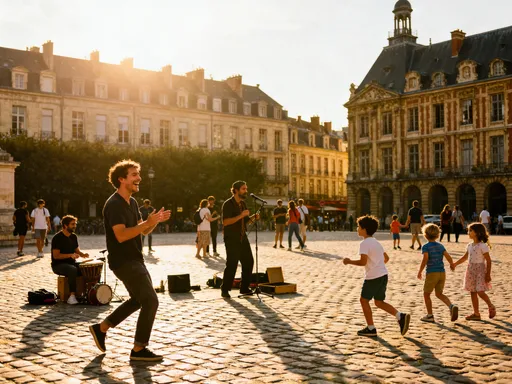
Place Royale, with its symmetrical layout and central equestrian statue, exemplifies 18th-century urban planning at its most elegant. Yet today, it functions as a living room for the city. On weekends, families spread blankets on the grassy corners. Buskers perform near the fountain, drawing small crowds. Cyclists pause to lock their bikes before heading into nearby boutiques. The square doesn’t demand reverence—it welcomes participation. Similarly, Place du Bouffay, nestled in the medieval quarter, pulses with energy from its surrounding cafés and bistros. At night, the warm glow from restaurant windows spills onto the cobbles, and laughter drifts into the air. These spaces succeed because they are not preserved in amber; they adapt, breathe, and grow alongside the people who use them.
The cultural importance of such spaces cannot be overstated. They act as social equalizers, where people from all walks of life cross paths without hierarchy. A businessperson might share a bench with a street artist. A tourist asks for directions and ends up in a 20-minute conversation about local music. These micro-interactions build the fabric of community. For visitors, engaging with these spaces offers a rare window into authentic city life, far removed from curated tours or crowded attractions. In Nantes, the public realm isn’t just a backdrop—it’s the main event.
From Industrial Past to Vibrant Present: The Rebirth of Nantes’ Cityscape
Just a few decades ago, Nantes faced the same challenges as many post-industrial European cities. Once a thriving port on the Loire River, it saw shipyards close, factories fall silent, and waterfront areas become neglected zones of concrete and rust. The city’s identity seemed caught between memory and decline. But rather than retreat from its industrial legacy, Nantes chose to reimagine it. Beginning in the 1980s and accelerating in the 2000s, a bold vision for urban renewal took shape—one that prioritized people over parking lots, greenery over gray infrastructure, and creativity over convention.
The transformation was not driven by flashy skyscrapers or luxury developments, but by a commitment to public space as a catalyst for change. Along the Loire and Erdre rivers, former industrial plots were cleared and reimagined as continuous green corridors. Old warehouses gave way to cultural centers, bike paths, and open lawns. One of the most significant shifts was the pedestrianization of key zones. Streets once dominated by cars were reclaimed for walking, cycling, and gathering. This didn’t happen overnight, nor was it imposed from above. City planners engaged residents through public consultations, ensuring that renewal reflected local needs and desires. The result was not a top-down redevelopment, but a collaborative rebirth.
Today, the effects are visible everywhere. The banks of the Loire, once lined with cargo terminals, now host sunbathers, picnickers, and paddleboarders. The Erdre River, often called the “Venice of the West,” has become a haven for rowing clubs and weekend strollers. Abandoned rail yards have been transformed into linear parks, connecting neighborhoods that were once divided by infrastructure. Even former factory smokestacks have been preserved as landmarks, not out of nostalgia, but as reminders of where the city has been—and how far it has come.
This evolution reflects a broader trend in sustainable urbanism: the idea that cities should grow inward, not outward. Instead of expanding into greenfields, Nantes invested in underutilized urban land. This approach reduced sprawl, lowered emissions, and strengthened community ties by revitalizing existing districts. It also created a sense of continuity—new developments respect the scale and texture of older areas, avoiding the jarring contrasts seen in other cities. The rebirth of Nantes’ cityscape is not about erasing the past, but about weaving it into a more livable, inclusive future. The message is clear: a city’s vitality doesn’t come from its tallest building, but from the quality of its everyday spaces.
Islands of Connection: Île de Nantes as a Living Experiment
At the heart of Nantes’ transformation lies Île de Nantes, a 2.5-kilometer-long island that once pulsed with the noise of shipbuilding and mechanical workshops. Today, it is one of the most dynamic public spaces in France, a bold experiment in urban regeneration that blends art, innovation, and daily life. Divided by the Loire River, the island was long seen as a barrier between neighborhoods. Now, it functions as a bridge—both physically and socially—connecting people through culture, recreation, and imagination.
The most iconic symbol of this reinvention is the Machines de l’Île, a fantastical project born from the collaboration of artists, engineers, and dreamers. At its center stands the Great Elephant, a 12-meter-tall mechanical creature that carries visitors on a slow walk along the quay. Children gasp as steam hisses from its trunk; adults marvel at the craftsmanship. Nearby, the Carousel of Marine Worlds invites riders into a surreal underwater universe filled with moving sculptures of whales, jellyfish, and extinct sea creatures. These installations are not mere attractions—they are public art on a grand scale, freely accessible and deeply embedded in the island’s identity.
Beyond the machines, Île de Nantes thrives as a mixed-use district. Wide, tree-lined avenues accommodate cyclists, pedestrians, and trams with equal ease. Public plazas host outdoor film screenings, food trucks, and dance performances. The Les Anneaux—a massive, multicolored ring sculpture spanning the river—doubles as a pedestrian bridge and a light installation that changes color with the seasons. At night, it glows like a necklace draped across the water, drawing people to linger and take photos. Along the banks, grassy slopes invite spontaneous picnics, while floating gardens add ecological value and visual beauty.
What sets Île de Nantes apart is its balance between spectacle and utility. Unlike theme parks or commercial developments, it doesn’t feel artificial or exclusive. Families come to play. Artists set up easels. Joggers loop the island’s perimeter path. The space is designed to evolve, with temporary installations and community workshops regularly refreshing its energy. This adaptability ensures that the island remains relevant and engaging, not just a one-time novelty. It stands as a model of how industrial spaces can be reimagined not as relics, but as living, breathing parts of a city’s social fabric.
Green & Grounded: Parks That Invite You In
If public squares are the living rooms of Nantes, its parks are the backyards—spacious, welcoming, and essential to daily well-being. Among them, Jardin des Plantes stands out as one of the finest municipal gardens in France. Opened in the 19th century, it spans over ten hectares and combines formal landscaping with naturalistic areas. Wide gravel paths wind past rose gardens, medicinal plant beds, and a small zoo that focuses on local species. A greenhouse shelters exotic plants, while open lawns host kite-flying children and chess-playing retirees. The park’s design reflects a deep respect for both beauty and biodiversity, offering something for every age and interest.
What makes Jardin des Plantes truly special is its inclusivity. Raised beds allow wheelchair users to tend flowers. Sensory gardens engage visitors with visual, tactile, and aromatic experiences, making nature accessible to those with visual impairments. Play areas are designed for children of all abilities, with adaptive swings and tactile pathways. These thoughtful details reflect a city that sees public space not as a one-size-fits-all proposition, but as a shared responsibility to accommodate everyone. Families return week after week, not just for the greenery, but for the sense of belonging it fosters.
Another standout is the Jardin des Droits de l’Homme, located near the university district. Smaller in scale but rich in symbolism, this park was designed to reflect the values of liberty, equality, and fraternity. Its open layout encourages gathering, with wide sightlines and minimal barriers. Benches are arranged in circles, promoting conversation. A reflective pool mirrors the sky, changing with the weather and time of day. The park hosts public readings, student protests, and quiet study sessions, serving as both a civic space and a sanctuary. Its name reminds visitors that public space is not neutral—it carries meaning, history, and the potential for dialogue.
Across Nantes, green spaces are not isolated oases, but connected nodes in a larger ecological network. Tree-lined boulevards link parks to neighborhoods. Rain gardens manage stormwater while adding beauty. Beehives on rooftops and wildflower meadows support pollinators. These efforts are part of a broader commitment to urban sustainability, ensuring that nature is not an afterthought, but a core component of city life. For residents, these parks offer relief from urban density. For visitors, they provide a chance to slow down, breathe deeply, and experience the city at a human pace. In a world where green space is increasingly scarce, Nantes shows how nature and urbanity can coexist in harmony.
Markets, Music, and Movement: Public Life in Action
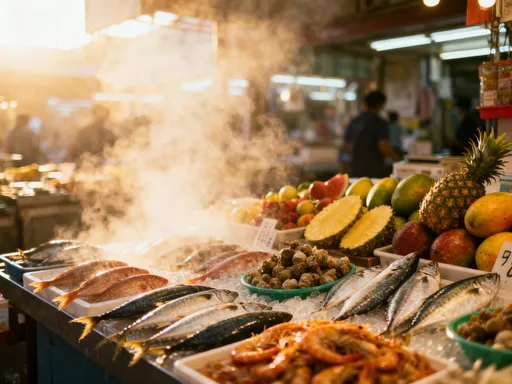
The true spirit of Nantes reveals itself not in silence, but in sound. On any given morning, the air fills with the clatter of market stalls, the sizzle of crêpes on griddles, and the friendly banter of vendors greeting regulars. Marché de Talensac, housed in a striking iron-and-glass hall, is a sensory feast. Butchers display fresh cuts with pride. Farmers arrange pyramids of seasonal fruit. Bakers pull golden loaves from ovens while the scent of yeast drifts into the street. This is not a market for show—it’s a working marketplace where locals do their weekly shopping, exchange news, and taste before they buy.
Public life in Nantes is also shaped by movement. Along the Loire, cyclists glide past joggers and dog walkers. In the summer, outdoor yoga sessions draw crowds to grassy riverbanks. Dance troupes perform flash mobs in unexpected squares. These activities are not confined to special events—they are woven into the rhythm of daily life. The city supports this vitality through low-cost or free programming. Summer festivals bring live music to parks. Winter lights transform streets into glowing pathways. Temporary installations—a pop-up cinema, a mobile library, a chess table in an empty lot—inject spontaneity into familiar spaces.
Street performers add another layer of energy. Near Théâtre Graslin, a violinist plays classical pieces with surprising emotion. In Place du Commerce, a mime captivates children with silent gestures. A jazz trio sets up near the cathedral, drawing listeners who pause, close their eyes, and sway. These moments are unscripted, fleeting, and deeply human. They remind us that public space is not just for transit or transactions—it’s for expression. The city’s support for such activities reflects a belief that culture should be accessible to all, not locked behind ticketed doors.
This culture of activation ensures that no square feels empty or forgotten. Even minor spaces are given purpose: a forgotten corner becomes a reading nook; a blank wall turns into a rotating art gallery. The result is a city that feels alive at all hours, where every visit offers the possibility of surprise. In Nantes, public life isn’t something you watch—it’s something you join.
Design That Works: What Makes Nantes’ Spaces So Inviting?
The success of Nantes’ public spaces is no accident. It is the result of deliberate, human-centered design. At the core is walkability. Sidewalks are wide, well-maintained, and free of obstacles. Crosswalks are frequent and clearly marked, making it easy to navigate on foot. Traffic speeds are kept low in residential and commercial zones, ensuring safety for pedestrians and cyclists alike. This prioritization of non-motorized transport sends a clear message: people come first.
Lighting plays a subtle but powerful role. Street lamps are evenly spaced, casting a warm, inviting glow without harsh glare. In parks and plazas, lighting is designed to highlight trees, fountains, and seating areas, creating pockets of warmth after dark. This encourages evening use, whether for a romantic stroll or a late-night chat with friends. Safety is enhanced not through surveillance, but through visibility and activity—a well-lit, well-used space feels secure by design.
Seating is another hallmark of thoughtful planning. Benches are strategically placed to face interesting views—fountains, street performers, children playing. They come in various forms: wooden slats, stone ledges, even repurposed logs, offering choices for different preferences. Some are heated in winter, extending comfort across seasons. The abundance of seating invites停留—lingering, resting, observing. In many cities, people stand because there’s nowhere to sit. In Nantes, sitting is part of the experience.
Scale matters too. Buildings near public spaces are generally low-rise, preserving sightlines and sunlight. Tree-lined avenues create a sense of enclosure without feeling oppressive. Pavement materials are chosen for both durability and aesthetics—cobblestones in historic areas, smooth stone or concrete in modern zones. Even small details, like the texture underfoot or the sound of footsteps, contribute to the sensory experience. These choices reflect a deep understanding of how environment shapes emotion. A space that feels good to be in doesn’t just happen—it’s carefully crafted.
How to Experience Nantes Like a Local: A Practical Approach
To truly feel Nantes, set aside the checklist and embrace slowness. Begin in the morning at Jardin des Plantes, where dew still clings to rose petals and seniors practice tai chi near the duck pond. Walk east toward the Loire, following the tree-lined path that hugs the riverbank. Cross into Île de Nantes via the Passerelle Victor Schoelcher, a pedestrian bridge that offers panoramic views. Visit the Machines de l’Île early, when lines are short and the morning light softens the metal surfaces.
By midday, head to Marché de Talensac. Sample a goat cheese tartine from a local vendor, pair it with a slice of ripe melon, and enjoy your lunch on a nearby bench. Afternoon is perfect for exploring the smaller squares—Place du Bouffay for its medieval charm, Place Royale for its symmetry and fountains. If the weather is warm, rent a bike and ride along the Erdre River, stopping at a waterside café for a lemonade.
In the evening, let the city guide you. Check local listings for free concerts in the parks or outdoor film screenings on Île de Nantes. Join a group yoga session on the grass, or simply find a quiet spot by the water to watch the sunset. The best moments often come unplanned—a street musician playing a haunting melody, a child’s laughter echoing across a plaza, the sudden hush as a flock of birds rises from the river.
Experiencing Nantes like a local means being open to these small, authentic interactions. It means walking without a map, sitting without a schedule, and allowing the city to reveal itself in its own time. These shared spaces do more than entertain—they remind us of our common humanity. In a world that often feels divided, Nantes offers a quiet lesson: that belonging begins when we step into the open, and simply stay awhile.